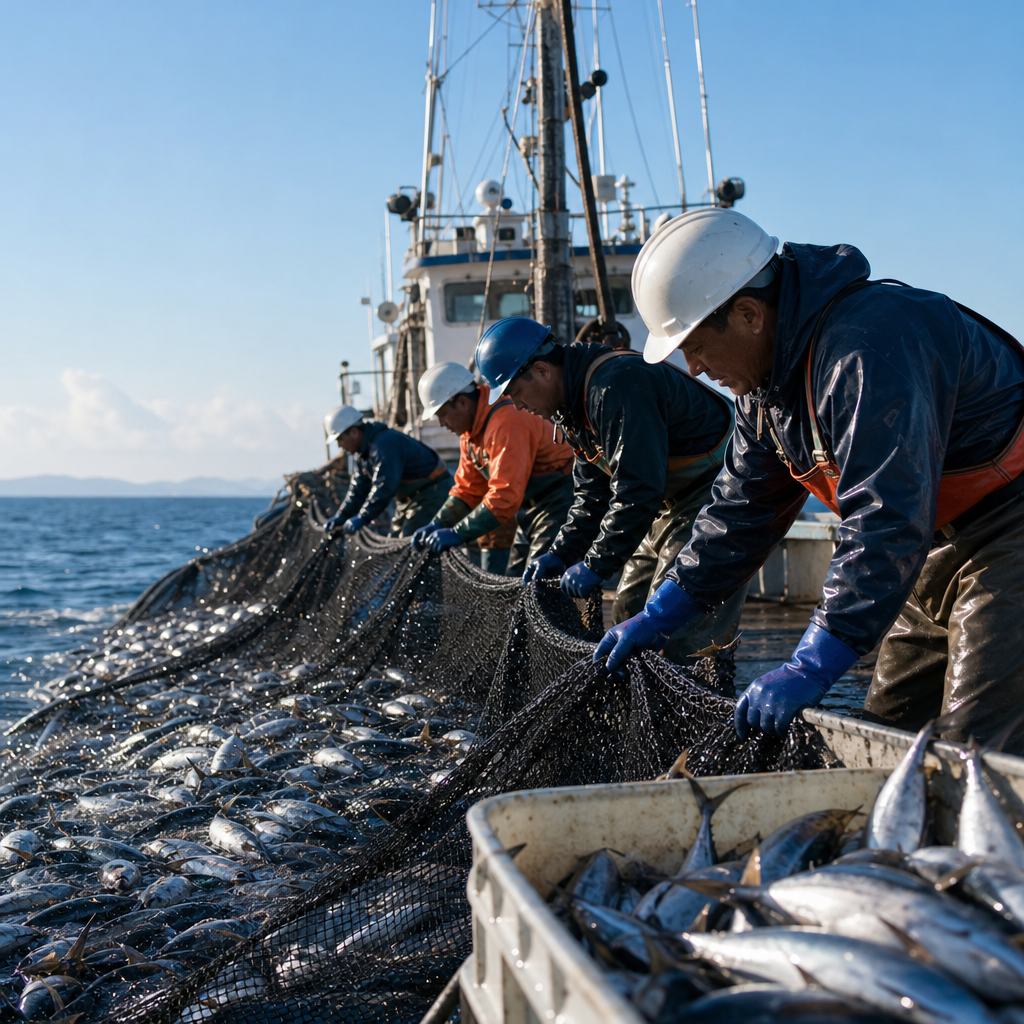
Ausin Group connects every node of the seafood supply chain: aquaculture breeding, open-sea harvesting, processing, and cross-border logistics across Malaysia, China, and Thailand.
Contact Our Team →Six integrated service lines, built to eliminate the fragmentation that costs procurement teams time and supply reliability.
Controlled hatchery operations producing consistent juvenile stock for downstream grow-out. Genetic selection protocols reduce mortality rates and shorten harvest cycles for commercial-scale buyers.
A managed fleet operating in certified fishing zones across Malaysian and regional waters. Catch volumes are tracked vessel-by-vessel, providing the traceability documentation that institutional buyers require.
In-house feed manufacturing calibrated to species-specific nutritional profiles. Vertical control over feed inputs removes a critical variable from grow-out performance and reduces third-party dependency.
HACCP-certified processing facilities handling filleting, freezing, grading, and packaging to export specification. Output formats are configurable to meet retailer, foodservice, or wholesale buyer requirements.
Cross-border cold chain logistics connecting production sites in Malaysia with distribution hubs in China and Thailand. Temperature-monitored throughout, with real-time status available to procurement partners.
Technical advisory for hatchery setup, feed formulation, regulatory compliance, and market entry across ASEAN. Designed for operators building or scaling fisheries infrastructure in the region.
Ausin Group was established as Malaysia's answer to a specific problem: the seafood supply chain is structurally fragmented, and that fragmentation is expensive. Procurement heads lose consistency when breeding, harvesting, processing, and logistics are managed by separate operators with separate incentives.
Ausin Group consolidates that entire chain under a single operational structure. Hatcheries, fishing vessels, feed mills, processing plants, and cold chain logistics are all internal capabilities, not subcontracted dependencies. That integration is what makes supply consistency a deliverable promise, not a best-effort aspiration.
Operations span Malaysia, China, and Thailand. The consultancy division supports regional operators building equivalent infrastructure, drawing on the same technical systems Ausin uses internally.
Supply consistency is not a procurement problem. It is an infrastructure problem. Ausin Group solves it at the source.
Every operational decision at Ausin Group traces back to these commitments, which are visible in facility design, process documentation, and partner agreements.
Every product in the Ausin chain carries documentation from breeding batch or vessel catch through to final packaging. Institutional buyers receive the traceability records that export markets and regulatory bodies require, without additional audit burden.
Hatchery and grow-out operations run on documented protocols, not intuition. Water chemistry, feed conversion ratios, stocking densities, and harvest timing are managed against measurable benchmarks. The result is predictable output, not seasonal variance.
Temperature excursions are the most common cause of cross-border seafood loss. Ausin's logistics infrastructure maintains continuous cold chain from processing through to final delivery across Malaysia, China, and Thailand, with monitoring data available to partners on request.
Fragmented supply chains create three recurring problems: inconsistent volume, documentation gaps, and no single point of accountability. Ausin Group is structured to eliminate all three.
One contract, one contact, one operational system. When supply issues arise, there is no chain of third-party blame. Ausin controls the inputs, so Ausin owns the outcome.
Dual sourcing from aquaculture and open-sea operations provides buffer against seasonal catch variation. When wild catch is constrained, farmed volume compensates, and vice versa. Buyers receive consistent allocation.
Every shipment exits Ausin facilities with the certification package required for China and Thailand import clearance: HACCP records, catch certificates, cold chain logs, and species verification. No retrospective paperwork requests.
Ausin Group maintains active operations in Malaysia, China, and Thailand. Each market has distinct regulatory requirements and buyer expectations. The same integrated system serves all three, adapted locally.
| Service Line | Facility Type | Output Format | Markets Served | Certifications |
|---|---|---|---|---|
| SVC-01 Aquaculture Breeding | Controlled hatchery | Juvenile stock, fingerlings | MY | ISO |
| SVC-02 Open-Sea Fishing | Managed fishing fleet | Fresh/chilled whole fish | MY, CN, TH | Catch Cert |
| SVC-03 Feed Production | Feed manufacturing mill | Pelleted compound feed | MY | CE |
| SVC-04 Seafood Processing | Processing plant | Fillets, IQF, retail packs | MY, CN, TH | HACCPISO |
| SVC-05 Cold Chain Logistics | Refrigerated transport | Cross-border delivery | MY, CN, TH | Temp Log |
| SVC-06 Consultancy | Advisory services | Technical reports, site audits | MY, CN, TH, ASEAN | ISO |
Ausin Group's primary operational and administrative presence is in Malaysia, with active trade corridors into China and Thailand.
Whether you are sourcing at volume, evaluating a new supply corridor, or scoping a consultancy engagement, the right starting point is a direct conversation with our operations team.
Contact Us →